Thursday, July 28, 2011

The silent work force. (part two)


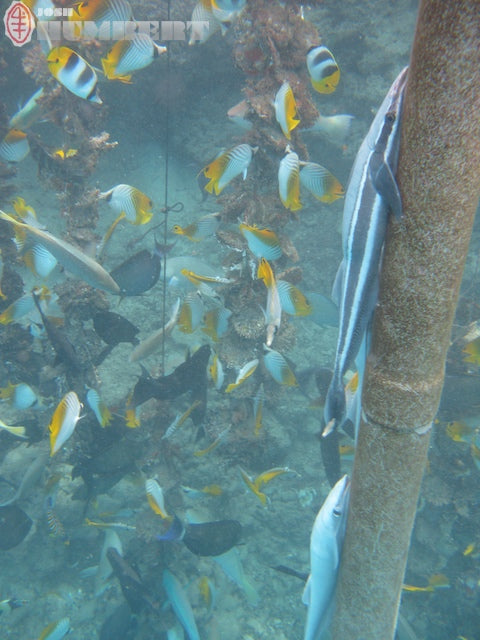
Two remoras hang from their suction-cup heads while Kamoka's silent work force happily nibbles away.

As the morning wore on and the piles of pipis, etc accumulated I noticed that when I went to fetch more cords of oysters from the temporary holding platform in front of the farm, they would be increasingly clean.  As a child I had always been mesmerized by fish and growing up I told myself that someday I would live where I could feed fish outside my door.  Now, I was watching fish feed every day which was (and still is) a huge delight.  The early years of the farm were all about hard work and we were fully committed to getting the job done, no matter how tired, stung or otherwise tortured.  So when I told suggested to my father Patrick that I thought we might not need to scrape the oysters at all, I wasn't surprised at his reaction of exasperation.  What had I learned in school in America and when would I start to work like a man?  I wasn't sure what I had learned in school either but I was pretty sure that the fish were ready to do our job for us.

It quickly became obvious to both of us that scraping oysters clean was a thing of the past.  My father designed several underwater platforms in shallow zones where fish were numerous and soon we were cleaning huge numbers of oysters by simply leaving them on the platforms for a day or two.

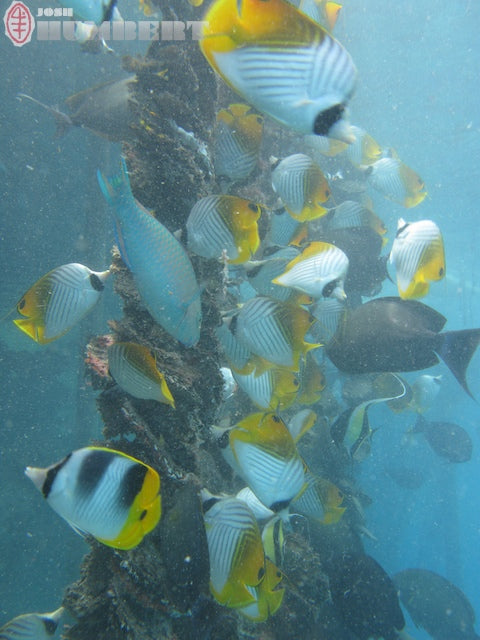
As time went on, it also became obvious that our fish populations were thriving.  Even more exciting was a strengthening of all the species across the board.  I visited a farm in Manihi once that had an unnaturally large population of Kotimu (Sergeant Majors).  They are an aggressive fish and their numbers had ballooned due to the habit the farmer had of throwing his oyster scrapings and table left-overs into the water.  Letting the fish clean the fouled oysters didn't have this effect because the surface area to be cleaned was just too vast for one species to dominate.  It also became clear that different fish were suited to eat different things.  The delicate butterfly fish could stick their pointy snouts into crevices and extract the anemones, the brutish parrotfish went straight for the pipis that they found a welcome change from the coral they usually grind,  the surgeon fish devoured any form of algae and on it went, every organism that had taken up residence on the oysters was dutifully removed by it's corresponding fish.

According to the account of early explorers, these desolate atolls had fish populations many times more robust than they are today.  I believe that Tahitian pearl farming done in the way we do it at Kamoka can help to restore fish stocks to their original states.  I believe this is one of many reasons that makes Kamoka tahitian pearls the most ecologically sound pearls in the world and makes them truly something that we can feel good about wearing.

Thursday, July 21, 2011

The silent work force. (part one)


Farmers typically grow their oysters far off the lagoon floor so, much like a sailboat's hull that fouls up, they become homes to whatever finds them.  Our oyster, the Pinctada margaritifera, is a lover of clean water so it is typically farmed near the surface, in depths of normally 20-60 meters deep.

Just about everything in the ocean starts life so small that it has no choice but to drift with the current until it either develops it's own means of locomotion like fish or it finds a place to settle.  Pearl oysters provide such a place so if they are left alone they essentially begin to turn into living reefs, complete with corals, crabs, anemones, fish, sponges, you name it.  One of a pearl farmer's biggest and dirtiest jobs is removing these competing species so that the oysters can be healthier and thus create more beautiful pearls.  For years we did as the few other farms did, scrape endlessly only to scrape again a short time later.  Very much a marine version of Sisyphus and the rock he pushed up a hill.

Early one morning like all the other mornings, we had gone out to get strings of grafted (seeded) oysters that had young pearls growing in them for three months.  At the time of nucleation they had been perfectly clean and now just 90 days later they were unrecognizable with "bio-fouling."  Each string had ten oysters spaced out evenly over six feet of cord but only rarely could you even tell that an oyster was there.  The most aggressive of the real estate claimers is an oyster species called Pinctada maculata, locally known simply as "Pipi."  In some atolls, they grow abundantly in zones where fish are few and are well known for their prized natural pearls, "poe pipi" (poe = pearl in Tahitian).  To Tahitian pearl farmers they are a scourge though, competing for food and oxygen by carpeting the species farmers try to cultivate.

Anemones were spread throughout the pearling islands and atolls in the early to mid 90's by farmers buying oysters from neighboring islands where they were either cheaper or more readily available.  With no shell or exoskeleton to grow, they typically out-compete everything, growing shockingly fast in a matter of days only.  They sting the outer lip of the oyster they grow on, crippling it and severely affecting pearl quality.  Worse still is that they often detach or break into bits when we dive to move the oysters around.  Contact with the skin feels like middle ground between a mosquito and bee sting.  After a dive with anemones, swollen faces and stings on various body parts are often the case.

For part two, please tune in next week.

Thursday, July 14, 2011

Running free.


Photo: Jasmine HUMBERT


When we moved to America from Tahiti last summer we packed up our house, put most of it in a container then flew off with just a few bags.  The most amazing part of the experience was living the three months with only a few items of clothing and some random things that didn't make it into the packing boxes.  When the container finally showed up, I half wanted to make a big bonfire and start this new adventure in our lives with less STUFF.  I've always prided myself on living outside of the habits of modern consumer society but here was a mountain of things that we didn't need.  An undeniable litmus strip of truth in the form of 57 boxes.

Back up three months from then and we had freshly arrived.  The departure from Tahiti had been a nightmare for me for many different reasons then just days before leaving, a dear friend who had been one of the pillars of the pearl farm in it's early years, passed away in the prime of his life, adding a dimension of difficulty I was totally unprepared for.

At an hour and half's distance from the ocean, I knew that my outlet and source of comfort that I had relied on for the last couple of decades was out of reach.  Sure I'd be able to get away to the coast every now and then but my daily fix would have to be closer.  In high school I was crazy into running cross-country so the choice was obvious that I would rekindle a love for running that had been sleeping for many years.

The Oregonian interviews me about running barefoot.

My running shoes however were boxed up in a container, cooking on a dock somewhere in the tropics.  Being too cheap to go out and buy new ones, I went to the trails anyway and discovered the magic of running without shoes.  I had run without shoes a few times back in high school but more as a lark than anything else.  The Nike waffle tread was all the rage and our cross-country team even built a ten foot long shoe every year affectionately named The Great Nike that (legend had it) would alight on the roof of the school gym the Friday before Halloween.

To my surprise running didn't make my body sore any more the way I remembered it.  Not long after starting I Googled barefoot running and my jaw dropped on seeing that there were weirdos online all over the world (but mostly in America) that were running un-shod and loving it like I was.

A Youtube frenzy followed and I learned how researchers have shown through treadmill impact tests that running with padding on your feet makes you come down dramatically harder on them than having no shoes at all.  Other videos showed slow motion images of how the arch of the foot is SUPPOSED to collapse with every foot strike.  In the running culture I used to be a part of in the late 80's this stuff would have gotten you hanged by your shoe laces.  The more I learned about how good it was to run without shoes the more it excited me.


How many other things do we take for granted as necessary that we could live very well without?


Friday, July 1, 2011

Pearl pirates, yarrr! (part two)


The sound of the approaching boat became louder, confirming our guess that it was our neighbor with his rowdy friends on their way home from a bender in the village on the other side of the atoll.

“We better go have a look,” my father said in French.  I knew he was right, but having never been in a fight in my life, the idea of confronting a boat of several big, probably drunk guys made me feel more than a little unsure.

We hurried to our aluminum boat, grabbing a fish gaff and a broom-length hardwood dowel heavy enough to knock out an elephant.  I really, really didn’t want to use either, but I wanted even less to be left with only my bare hands.

After firing up the outboard, we cast off from the dock into the moonless night while the wind whipped the chilly lagoon water at us.  After driving into the chop for 400 meters, we spotted the boat stopped where we had expected it to be.  I could feel my heart slamming in my chest.  We could barely make out several people in the darkness, including one getting back into our neighbor’s flimsy wooden boat.  My father threw a volley of insults at them to which we could just make out their replies over the roar of our motor and the white noise of the wind.  Much yelling followed but my fear dissipated as I realized that the only defense or offense we needed was our own v-bottomed aluminum boat.  If push had come to shove, it would have been very easy to sink their boat with ours.  They hurriedly got their motor started as we circled them again and again, and finally they puttered off into the night in the direction of their islet.

The next day a check on our oysters showed that the bandits didn’t have enough time to steal any.  Although relieved, I knew that the bandit situation would have to be resolved soon.  Our work was strenuous enough that we didn’t need the added strain and mental torment. 

A few days after the incident, a supply boat came with some of our gear, so we put work aside and boated the 6 km to the village where it docked.  At the time of this story (early nineties) there was no airport in Ahe yet; all supplies were delivered by cargo ships, whose rotations were notoriously irregular.  To locals, it always seemed like a small miracle when the cargo ships actually appeared. It was never all business when a supply boat came though: all the farmers whose homes and farms were spread out over the atoll would come together for some much needed socializing. 

We squeezed in between two boats and waited on the dock with some friends while people milled around.  I realized suddenly that Floresse was just a few meters away, on a path to walk by us, unaware of our presence.  My father saw him too and immediately jumped up to step in his path.  At my father’s height of 5’6”, Floresse could have almost stepped over him.  I jumped up as well and winced in anticipation as my father reached up to shove him in the shoulder, asking him angrily what it was going to take for him to leave us alone.  I saw Floresse stiffen and clench his hands but instead of taking a swing, he looked around at the crowd that had formed and to my surprise backed away.

The following week found us again at the village waiting for supplies.  This time we were sitting with our feet over the dock when Floresse approached.  Strangely, I hardly recognized him.  He hadn’t changed in any obvious way but just looked smaller.  He looked meek and embarrassed and smiled showing good will.  He explained in a tiny voice that he had come to excuse himself for the bad feelings and that it wasn’t his idea, it was the others that had pushed him to be that way. 

On a small island, the necessity of getting along with others is heightened in a way that is hard to understand for continent dwellers.  This was my first major lesson but far from my last or most adventurous.

To this day, twenty years later, we still have never had oysters disappear from our waters.  Pearls on the other hand are far easier to abscond with but that is a different story.

Tuesday, June 28, 2011

Pearl pirates, yarrr! (part one)


I could feel it in my eyelids as well as my legs and back and arms.  The moment I savored most each day was coming fast.  Pulling a sheet over me and laying my head on a pillow could only be described as sublime.  My dad Patrick, thirty-some years older and in his early fifties, had worked all day just as hard (if not harder), and I knew he was feeling it too. It was 9:20 PM and we both should have been fast asleep.
That day, like every other day of the week excepting Sundays, we had been up before dawn, worked all day and well into the evening, and were absolutely worn out when the moment came to shower and climb into bed.  Much of our work was underwater with compressed air sent to us via a hose called a “hookah rig.”  Our work below the surface was limited to the time it took for the compressor to use up a full tank of gas (about 6 hours).  The advantage was obvious over traditional bottle diving but for better or worse, it allowed us to spend blocks of time underwater that were long enough to drain us of every drop of energy.

Above water, we spent daylight hours preparing oysters to be sold to other farms who had the means to graft (or seed) pearls.  This was an endless job of first retrieving the oysters where they grew suspended over deep water, and then bringing them to the farm for processing—which involved gently removing them from their lines and drilling them with small holes to be hung again.  This work was a means of spacing out the oysters for optimum growth and tracking quantities.
Our night-time work was primarily tying knots so we would have “chapelets” or strings the next day for hanging oysters.

On this night, as we were settling in after an exhausting workday, a far-off drone became audible over the din of the trade winds that battered the farm night and day.  We both sat up and listened as a boat approached our plot of lagoon water.  We knew it was our neighbor Gilles.  He was a quiet guy who had come to live in Ahe from his native New Caledonia.  We had never had any problems with Gilles, but lately he had been rolling with a rough crew headed by Floresse, another new-comer who like Gilles had been attracted to the atoll by tales of easy money.  

Floresse stood at about 6 feet 4 inches.  Atop his broad, square shoulders was a head with wild sun-bleached locks of hair and small, light eyes fixed in permanent squints against the harsh tropical sun.  Despite his flowery name, his often intoxicated state made him prone to abusive language, which he had recently been yelling in the direction of our farm at night on his way to party with our neighbor.

Though we didn’t have pearls growing in them yet, our oysters represented serious sweat equity as well as monetary value, and oyster bandits are a problem that troubles every pearl farmer's sleep.  Polynesians especially are natural swimmers and divers—the thought of jumping into night water, diving 30 feet in the blackness and groping around for oysters won’t slow many of them down.

(Part two coming next week)


Monday, June 20, 2011

A day in the life of Kamoka Pearl.

 Spending the majority of my time now in Portland, OR I feel like I need to qualify what a "typical day" on the farm means to me.  My continuous days of non-stop pearl grafting are seldom now and I only occasionally get back to the farm.  Timi, Laurent, Heiarii and my father Patrick are faithfully there though so I want to walk you through a typical day in their board shorts.

An ordinary day on the farm starts at about 6:00 in the morning.  Laurent climbs down from the crow's nest, the control tower/crash-pad that can be seen in any picture of the farm.  He puts on a kettle of hot water while the other filter in.  The rest of the crew live on one of the two "motus" or islets in the atoll that make up the land mass of Kamoka Pearl.  With a little luck there will be a volunteer or two (sent out from the WWOOF Organization, www.wwoof.org) that has made fresh bread for a Euro-style breakfast.


After cups of black instant coffee get tossed back and bread is slathered with canned NZ butter and inhaled, gears click into place.  Heiarii and Laurent grab freediving gear and do a quick run out to the lines to get oysters for Timi to work on for the day.  The oysters grow on horizontal polypropylene lines that are from 200 to 600 meters in length and submerged at about 7 meters of depth over 40 meters of clean lagoon water.

While Laurent and Heiarii are diving, Timi is sharpening his scalpels, pouring his nuclei and filling a water bottle for some long hours in his chair.  Meanwhile, Heiari'i is opening oysters from the previous day and starting the painstaking process of searching for oysters that have a sufficiently colorful shell.  Once he finds these rare beauties, he'll put them aside and use them throughout the day for tissue donors.  A tissue donor is an oyster that is selected for it's exceptional color and then processed for it's mantle organ.  The mantle is what secretes the shell so in choosing shells of a particular color, we can influence the eventual color of the pearl.  One donor oyster will usually provide 20 -30 mantle pieces.


Soon after the divers return, Timi will have a tray full of oysters that Laurent has wedged gently open and held that way by pegs, usually made from clothes pins.  He'll then implant each oyster that he deems ready for the operation with a nucleus and a piece of living mantle tissue that he has prepared.  His challenge will be to graft as many oysters, as well as he can before lunch.  His dexterity will determine the quality of the pearls, the success rate and the number of oysters that make it safely through the operation.  All of the investment of a pearl farm rides on the shoulders of the grafter so predictably many farms have been sunk by sub-par grafters.  It's a job that requires skill, patience and long hours of practice to reach a passable status.  Timi joined the team in 1993 and has been grafting for about 12 years.  His mastery of the craft is immediately obvious to anyone who has the pleasure of observing him.

At lunch time, everything will get a saltwater wash down with a firetruck style black hose and the whole crew will stop for a needed break and food.  Food is usually rice with fish or chicken with some sort of salad that often will have some raw oyster muscle (that tastes a bit like a scallop) in it seized lightly with lime or vinegar (yum!).


Everybody helps with the cleaning and dishes and after about an hour has passed, work sparks back up until around 3PM.  The oysters that have been grafted throughout the day will then get brought back out to the lines, away from the farm where the water is most free from silt.  Timi is usually quick to join the dive crew as a dip in the lagoon is more than welcome after a full day of sitting in a chair.

After a final clean-up the crew will often throw freediving gear and spearguns in the boat and head to the pass for some fish, adventure and fun.  As well as being great exercise and a guaranteed good time, it's also a moment of camaraderie.  A tight-nit team is crucial to the overall health of the farm and the oysters as well as the quality of the pearls.

This is a fly-over account of a typical day.  If anyone wants more details about different parts mentioned above, please just leave questions in the comments below.  Thanks!

Saturday, June 11, 2011

Photos

My recent two week trip was full of photo goodness, from trippy moonlight photography to oil-still lagoon water, to pearl product photography on an unexpected model who was volunteering at the farm.  Here's a moonlit shot of Alain and I enjoying the warm breeze on the cabin of my dad's boat.  The lights on the horizon are the village of Uturoa and the lights in the sky are stars.  For more photography of Polynesia, pearls and surfing please check out www.joshhumbert.com.